Home Blog Page 7

Artificial intelligence-supported content management and automation

Artificial intelligence-supported content management and automation attracts attention with the smart solutions it brings to content production and management processes in today’s digital age. 

This technology optimizes business processes by using data analysis and learning algorithms in all processes, from content creation to distribution. 

Thanks to artificial intelligence, it is possible to better focus on the needs of the target audience, personalize and increase interaction in content production.

 At the same time, more effective and target-oriented strategies can be developed by analyzing user behavior in content distribution.

 Artificial intelligence-supported content management and automation thus makes business processes more efficient, saves time and resources, and gives businesses a competitive advantage.

Revolution in content management with artificial intelligence

Artificial intelligence-supported content management makes content creation and marketing processes more effective and target-oriented, enabling businesses to stand out in the digital field.

 Artificial intelligence-supported content management makes processes from content production to distribution smarter and more effective by using big data analysis and learning algorithms. 

Thanks to artificial intelligence, the trends and preferences of the target audience are better understood, thus accelerating content personalization and optimization processes.

 At the same time, artificial intelligence optimizes content distribution by understanding user behavior and offers businesses the opportunity to create and maintain a more effective digital presence.

 This revolution makes content management more efficient, scalable and goal-oriented, providing a significant competitive advantage in the business world.

The impact of artificial intelligence on content management processes

Artificial intelligence technologies allow businesses to manage their digital assets more intelligently and effectively. 

Artificial intelligence makes a difference in content production, personalization, and distribution processes through big data analysis and learning algorithms.

This technology makes content marketing more effective with the ability to deliver customized and engaging content to the target audience. 

The integration of artificial intelligence into content management processes stands out as a step that carries digital marketing strategies into the future.

Automatic content creation and editing

Artificial intelligence offers businesses a groundbreaking solution in content production by bringing an innovative approach to automatic content creation and editing processes. 

This technology enables the rapid creation of text-based content by using natural language processing and learning algorithms. 

At the same time, artificial intelligence-supported editing allows the creation of effective content at a professional level by optimizing elements such as grammar, intonation and content consistency.

SEO and artificial intelligence: New approaches to content optimization

Artificial intelligence allows search engines to better evaluate the content with its algorithmic understanding.

 In particular, natural language processing and machine learning techniques aim to be effective in rankings by not only ranking content with keywords but also by understanding the meaning of the content more deeply.

This leads content producers to create content considering not only search engine rankings but also user experience. 

SEO and artificial intelligence integration open a new era in content optimization, highlighting user-oriented and quality content and making digital marketing strategies more effective.

Content recommendation systems and user experience

Content recommendation systems are becoming one of the key elements that enrich user experience on digital platforms. 

These systems analyze the user’s past interactions, preferences and behaviors and offer personalized recommendations. 

These systems, which use machine learning algorithms to predict content that may interest users, aim to provide a more meaningful and customized experience. 

Content recommendation systems improve user experience and increase the time spent on the platform.

 These systems, which also increase customer satisfaction, enable users to encounter more content relevant to them on the relevant platform. 

What will be the cloud investment trends in 2024?

0

In today’s technology world, the transformative power of artificial intelligence and automation is becoming the main motivation for cloud investments. 

Many IT leaders prioritize the use of these technologies in their business processes due to their advantages. 

When planning cloud investments in 2024, businesses need to ensure that artificial intelligence and automation are compatible with company strategies in terms of organizational goals, financial forecasts, personnel recruitment and talent acquisition.

business goals

IT leaders need to take responsibility to ensure that AI and automation initiatives are aligned with the organization’s goals. 

It is crucial to evaluate whether proposed initiatives or use cases for artificial intelligence have strategic value. 

For example, deciding to get support from various artificial intelligence tools to automate certain tasks speeds up business processes, and thus employees allocate the time they save to tasks in which they can take a more active role. 

At the same time, the alignment between AI automation strategies and public cloud goals becomes indisputable. At this point, IT leaders must define whether artificial intelligence and automation are the solution itself or a part of it. This distinction becomes even more important considering the complexity between AI and traditional IT solutions.

ROI and TCO analysis

IT leaders need to fully analyze the Return on Investment (ROI) and Total Cost of Ownership (TCO) before investing in AI and automation initiatives.

 TCO for AI and automation includes not only implementation costs, but also cloud storage fees, data transfer fees, and costs associated with cloud-focused machine learning services. 

However, it is critical for IT leaders to carefully calculate the ROI of artificial intelligence and automation initiatives. Therefore, intelligence and automation initiatives need to be addressed through change management methodologies.

Data quality and availability

The success of an artificial intelligence and automation initiative lies in ensuring that the business has enough available data and that this data can be easily moved to the cloud. 

Institutions that do not have sufficient data must first prioritize initiatives to structure and collect this data. 

When a business chooses to build its own AI and automation solutions rather than leveraging off-the-shelf solutions, ensuring data accuracy is critical.

 Additionally, issues IT leaders need to address include cloud data availability, residency, backups, cost, and compliance. 

Technology selection

When choosing an artificial intelligence and automation solution, working with a supplier that specializes in these areas helps businesses start the process on a more reliable basis. One of the factors to be taken into consideration is the required workforce requirement. 

Considering that both remote and hybrid working will continue in 2024, it is anticipated that cloud-based flexible technologies will be needed that allow personnel to work from wherever they are.

 Therefore, integrating artificial intelligence-supported anomaly detection into the entire system is of great importance to monitor performance.

 Artificial intelligence enables active monitoring of resource usage in the workforce, troubleshooting problems, identifying performance bottlenecks and identifying deviations from goals. 

At every step of choosing a new technology, the organization’s current technology infrastructure, long-term goals, connections with business partners and, finally, relationships with customers need to be taken into consideration. 

When choosing a new technology, IT leaders need to take into account that they can quickly and easily access new features and enhancements when they use services from industry leaders such as Microsoft, Google and AWS.  

Security plans

Although artificial intelligence and automation are mainly hosted on reliable cloud platforms, service interruptions can cause processes to be disrupted. That’s why IT leaders need to be aware of the unique challenges of AI and automation. 

It is predicted that in 2024, artificial intelligence and automation will play a significant role in improving security measures. 

It is predicted that businesses will increasingly use these technologies to effectively define and automate AI-powered solutions. By taking advantage of the capabilities of artificial intelligence and automation, businesses aim to strengthen their defenses, intervene with weaknesses and strengthen their general security infrastructure.

Talent and expertise

Team expertise and training play a critical role in a business’s ability to successfully carry out artificial intelligence and automation activities, especially in the cloud. IT teams must have specialized capabilities to design and execute AI and automation applications in a preferred cloud or multi-cloud. 

As businesses use artificial intelligence, the value of training and studies on this technology increases, and it becomes more important than ever to ensure that institutions obtain a return on investment.

 It is becoming increasingly critical to continuously evaluate existing talent, identify expertise gaps, and create a recruitment strategy to increase skills.

The role of digital marketing in business

0

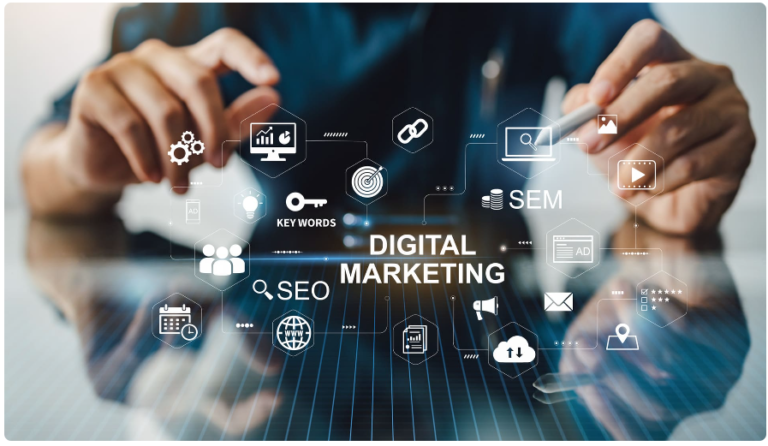
Digital marketing, which is increasingly important in the business world, allows consumers to be reached faster, directly and more effectively via the internet and other digital platforms, compared to traditional marketing techniques.

 Businesses use a variety of tools to promote their brands, acquire new customers, engage existing customers and increase sales through digital marketing strategies .

 These include tools such as search engine optimization (SEO), social media marketing, email marketing, search engine advertising (SEM), content marketing.

Digital marketing also offers tools that allow businesses to track and analyze customer behavior. 

In this way, businesses can better understand the needs and demands of their customers, better optimize their marketing strategies and increase customer satisfaction.

The impact of digital marketing on business

Digital marketing helps businesses expand their customer base, increase brand awareness and sales. With consumers’ increased internet usage, digital marketing allows businesses to reach a wider audience.

 In addition, digital marketing can be implemented at lower costs than traditional marketing techniques and the results can be measured. In this way, businesses can use their marketing budgets more efficiently. 

Digital marketing also helps better understand customers’ needs and demands, builds customer loyalty and increases sales. For all these reasons, digital marketing has become an indispensable tool for the business world.

What is digital marketing and how does it work?

Digital marketing is a type of marketing used to promote products and services, acquire customers and increase sales through the internet and other digital channels.

 Digital marketing uses a variety of techniques and tools such as search engine optimization (SEO), social media marketing, email marketing, search engine advertising (SEM), content marketing.

Digital marketing strategies and tools

Digital marketing strategies are designed to suit customers’ needs and used to achieve specific goals (e.g.

increased sales, brand awareness, improved customer relations). These strategies include the proper use of digital marketing tools, analysis of target audiences, and measurements.

 As a result, digital marketing helps businesses communicate more directly and effectively with their customers, increase sales and grow their brand.

SEO, one of the digital marketing tools, is a technique used to ensure that a website ranks higher in search engine results pages.

 For example, a website that is advanced in terms of SEO is likely to appear at the top of Google. 

Social media marketing, which is frequently used in digital marketing, is used to interact with customers and promote products/services through social media platforms such as Facebook, Instagram, Twitter and TikTok.

 Email marketing is preferred to send marketing messages to potential customers or existing customers via email. 

SEM allows advertisers to post ads for specific keywords on search engines. Content marketing aims to attract customers’ attention by creating content such as blog posts, videos and infographics.

Advantages and disadvantages of digital marketing

Digital marketing helps businesses reach larger audiences. In addition, its low cost compared to traditional marketing techniques is an important advantage.

 Another important feature of digital marketing is that it produces measurable results. Using web analytics tools, businesses can measure the success of their campaigns and shape their strategies if necessary.

 Additionally, digital marketing strengthens customer loyalty by providing customers with a more personalized experience. Digital marketing increases brand awareness in the business world, strengthens customer relationships and increases sales.

Digital marketing also has its disadvantages. First of all, competition in the field of digital marketing is very intense. Businesses may lose customers because their competitors run better campaigns. 

Another problem with digital marketing is that since the process is completely managed by technology, technical problems may affect the success of the campaigns. Additionally, since customer information is kept digitally in digital marketing, this may lead to information security concerns.

Developer of energy consumption systems: who is it and what does it do?

0

With the development of residential and industrial infrastructure, the issue of reducing energy costs becomes more relevant than ever. We tell you who and how minimizes energy consumption

Who is an energy systems developer?

An energy systems developer is a specialist who creates software and hardware to manage energy consumption in various infrastructures, such as homes or industrial buildings. An energy systems engineer is also a technical professional whose primary task is to design the most efficient, economical, and reliable energy systems. He knows what tools to use so that the refrigerator or air conditioner consumes the least amount of energy. He also works in large enterprises: hydro, gas and oil companies hire such a specialist to reduce the impact of their production on the environment and use resources more efficiently\.

What does an energy systems developer do?

Because the energy systems engineer’s primary focus is reducing energy consumption while increasing efficiency, he may perform many surveys, site inspections, and pilot studies. It conducts analysis based on data received from sensors, meters and other devices. Develops energy management systems taking into account economic efficiency and environmental safety.

In general, such a specialist is a key player in the field of sustainable development , since proper energy management can reduce the burden on the environment and reduce utility costs. Here are a few other responsibilities that typically fall under the purview of a power system designer:

integration of energy systems with building management systems, vehicle technical support and other systems;
support and development of energy management systems at all stages of the life cycle;
creation of software and hardware solutions for managing the supply of electricity, heat and water within one system;
analysis and optimization of energy consumption;
integration of various control systems, for example, heating, ventilation and air conditioning, lighting, etc.
Skills required in the profession
An energy system designer looks at current energy consumption problems, so in the energy industry, critical thinking can help look at a problem and find the optimal solution.

The energy sector is always at the forefront of advanced technologies, so if such a specialist works in the industry, he must be ready to quickly adapt to various innovations as they appear. Other key skills may also include:

knowledge of electrical engineering, ergonomics, construction;
programming skills;
ability to process large amounts of information;
Analytical mind;
ability to conduct an energy audit and know the basics of 3D modeling;
ability to offer original solutions to complex technical problems.
Do not forget that the developer of energy consumption systems is a specialist who minimizes the consumption of electricity, and this is always a concern for the environment. Therefore, knowledge in the field of ecology will be an advantage.
ey. PowerMeter allows users to monitor household energy consumption anywhere there is an available network.

Where did the profession come from?

The predecessor of these specialists can be called energy specialists. After the construction of the first power station in the 19th century, it was the power engineer who began to control the distribution of electrical energy. With the development of technology, the profession has not disappeared, but some of the functions have been taken over by developers of power consumption systems.

How to become an energy systems designer

You can get secondary vocational education in the following specialties: “Power stations, networks and systems”, “Power supply” and “Relay protection and automation of electric power systems”. It is worth choosing any college that teaches these specialties. For example, Novosibirsk Industrial and Energy College . In universities, this is the direction of “Electrical Power Engineering,” which is available at the capital’s Moscow Power Engineering Institute or the State Electrotechnical University LETI named after V.I. Ulyanov. In addition, you can study this profession remotely through the MBA CITY Business Academy course .

5 big advantages that RPA brings to businesses

0

In the business world, data-driven business processes and an ever-increasing competitive environment force organizations to be more effective and efficient.

 Businesses that cannot make their business processes efficient enough may fall behind in the competition and face commercial risks. At this point, robotic process automation (RPA) solutions offer significant contributions to businesses.

What is robotic process automation?

RPA, which enables automating repetitive, rule-based and routine tasks in business processes, offers the ability to perform structured tasks without human intervention through software robots. 

These robots, which can work in application interfaces and databases by imitating the use of input devices such as keyboards and mice by employees, can complete the tasks assigned to them much faster than a human.

RPA, which makes business processes more efficient by allowing people to allocate their time to more strategic and creative tasks, can often be integrated into existing systems without requiring complex infrastructure changes. 

Thanks to this feature, businesses can quickly benefit from the advantages of automation technologies.

RPA, which is used in many areas from financial transactions to customer services, from human resources to supply chain management, allows you to reduce costs, reduce errors and make business processes faster by increasing efficiency. 

Therefore, many organizations are adopting RPA as an effective tool to optimize business processes and gain competitive advantage.

Significant benefits that RPA brings to businesses

Productivity increase

RPA speeds up business processes by automating repetitive and rule-based tasks. Automating processes instead of handling them manually helps increase efficiency and complete business processes faster. 

In addition, with the reduction of manual processes, there is a significant decrease in costs.

Directing employees to strategic tasks

RPA’s ability to undertake repetitive tasks creates opportunities for human resources in the business to undertake more complex, creative, and strategic tasks.

Instead of dealing with routine tasks, employees can produce more added value in areas such as improving business processes, customer relations and innovation.

Reduced error probability and increased quality

By automating routine and repetitive tasks, RPA minimizes the possibility of human errors by removing the human factor from business processes. Thus, the overall quality level increases along with customer satisfaction.

Fast and flexible application integration

RPA solutions that can be quickly integrated into existing systems help companies quickly adapt to changing business needs. The flexible structure of RPA enables businesses to gain a competitive advantage with its ability to provide solutions suitable for different business processes.

24/7 uninterrupted operation and strategic decision making

Unlike human employees, RPA systems can work at any time, any day of the week. With RPA, automated data analysis and reporting can be provided to managers to provide real-time information for strategic decision-making processes.

İnnova’s RPA solution increases efficiency by automating routine tasks

RPA , the robotic process automation solution developed by İnnova’s expert staff , ensures that specified business processes are completed by digital robots that imitate human actions. 

RPA robots benefit from rule-based artificial intelligence and workflow automation technologies; their tasks result in the ability to interpret, calculate, trigger responses, and interact with the necessary systems.

Innova RPA, which can operate uninterruptedly 24 hours a day, 7 days a week, offers businesses the opportunity to complete time-consuming routine tasks in the most efficient way possible. 

Offering businesses the opportunity to benefit from automation technologies without making any infrastructure changes, RPA easily adapts to changes and new tasks with its flexible and scalable structure. 

RPA, which provides institutions with increased speed and efficiency in business processes, also helps increase service quality.

 Thanks to RPA, businesses have the opportunity to increase customer satisfaction by using their resources better.

What is Big Data? Where and How to Use?

0

There have been many forces that have shaped the world since human history.

Developments such as the invention of fire, steam engines and electricity are the greatest examples of this shaping power. In recent times, the concept of power has evolved in a very different direction.

It has moved from muscle power to mechanization, and from mechanization to data-based.

We are in a data-based era called Industry 4.0, where data is everything. The most important concept of this period is “Big Data”. Let’s consider big data in more detail.

What is Big Data?

Big data is data made meaningful. Data is analyzed, classified, processed, and thus turns into usable information resources in a meaningful form, rather than as a pile of data.

Data becomes Big Data in three stages;

  • Merging: In this stage, data from many sources are brought together.
  • Managing: It is the stage of managing the data. When it comes to big data, there shouldn’t be a few documents that come to your mind. It is millions of data from hundreds of sources. Such a large amount of data needs to be stored. Companies solve this process internally or by using the cloud. Nowadays, there are people who store in both ways.
  • Analyze: Any data that is not analyzed has no meaning. Just storing data does not make it meaningful. For this reason, it is the most important analysis step of big data.

What are the Basic Features of Big Data?

Big data consists of five main components. These can be listed as follows:

  • Volume: The term used for the amount of data. This amount of data increases and decreases depending on the data processed.
  • Velocity: The time it takes to receive and process data is called speed. The higher the speed rating, the more valuable it is. The reason why there are many devices working with real-time speed today is that speed is an important component.
  • Variety: Having more than one data type is an example of diversity. For example, a text and a voice are two data types.
  • Verification: It is a term that has emerged recently and refers to data security. In line with this term, issues such as who can view and process the data and the accuracy of the data are discussed.
  • Value: Data is as valuable as it is meaningful. Valuable data also adds value to the organization. Unnecessary data stacks that do not meet the needs of the institution are worthless.

Why is Big Data Important?

Data is of irreplaceable importance today. The importance of data cannot be ignored in every sector, from tourism to industry, from education to health. Industry 4.0 and before had a business-oriented order, not a consumer-oriented one.

There was a product produced in line with this order and this product was sold. Production of the product should be increased or decreased in line with demand.

However, today there is great competition in every field, so it has become important not to produce products but to produce the product according to consumer demands.

It has become important to understand the consumer, learn their likes, find their needs and the times they may need them. We can consider it with an example.

Let’s say you want to buy a dress. You only looked at one dress on the website. The system detects this and brings the dress to you.

Let’s say you did a search on diapers, food, and baby clothes. The system detects that you are a parent and shows you more baby products. These examples constitute only a small portion of the big data.

Big Data Technologies and Data Analytics

There are various technologies and tools developed to easily manage the analysis of big data. Some of these tools and technologies are:

  • Hadoop: It is an open source platform for storing and processing big data.
  • Spark: It is a data processing engine that facilitates the processing of big data in real time. It works much faster than the Hadoop platform.
  • NoSQL Databases: Used to store and manage unstructured data.
  • Data Mining and Machine Learning: Methods used in big data analytics include data mining and machine learning. These techniques are used to discover patterns and relationships in data sets.
  • Visual Analytics Tools: These are tools used to understand data analysis visually. Tableau and Power BI are examples of visual analytics tools.

What are the Usage Areas of Big Data?

Big data is used in every field today. There is huge data, from the phones you have to the devices used in the industrial sector.

The simplest example is actually not far away, but inside your homes. When we get into the vehicle, we show you the existence of smart devices that ventilate the house and adjust the temperature before reaching your home.

Examples of usage areas include automatically turning on the light when we enter the house, and smart robot vacuum cleaners mapping and cleaning every area of ​​the house.

Big data has a very important place to make your work easier both in your daily life and in your business life.

As technology gradually develops and expands, it is likely that there will be an increase in its usage areas.

What is Apple Vision Pro? What are its features?

0

Constant developments in technology lead to the emergence of many innovative products that make our lives easier.

Among these innovations, Apple stands out with its visionary products. Apple develops devices that attract users’ attention with their high-end features and offer solutions that meet their needs.

In this article, we will examine the product called Apple Vision Pro and discuss its features.

What is Apple Vision Pro? What is it for? 

Apple Vision Pro is a smart device equipped with the latest technology and advanced features, aiming to make users’ daily lives easier.

This innovative product offers users a unique experience by bringing together the real world and the virtual world, thanks to its advanced technology.

Apple Vision Pro is designed in the shape of glasses and is equipped with a transparent screen.

Users can view digital content and information by combining it with the real world on this transparent screen.

For example, while a tourist is visiting a historical place, he can visually view the history and important information of that place through Apple Vision Pro.

One of the most impressive features of these smart glasses is the augmented reality (AR) experience.

Apple Vision Pro uses environmental sensing sensors to monitor your surroundings and provide instant information.

In this way, you can interactively position, move and interact with digital objects in the real world.

The functionality of Apple Vision Pro is not limited to tourist information only. Professional users can also use these smart glasses in business life.

For example, technical service employees can quickly access data on the device during field work and solve problems more effectively.

Healthcare professionals can optimize their treatment processes by instantly tracking patient information through the glasses.

What are the Features of Apple Vision Pro? 

Apple Vision Pro offers you a specially designed interface and ease of use. It turns an ordinary experience into an unforgettable one with its high-resolution screen, vivid colors and details.

Thanks to its powerful processor, it performs all kinds of operations quickly and offers uninterrupted use all day long with its long battery life.

This product also helps you take perfect photos thanks to its smart camera and advanced image processing features.

Advanced artificial intelligence algorithms automatically optimize your photos and make them even more stunning.

In addition, thanks to the high storage capacity of Apple Vision Pro, you can safely store all your memories and access them whenever you want.

Additionally, Apple Vision Pro has a user-friendly interface, providing ease of use. The initial guidance and step-by-step setup process helps users get started quickly. In addition, it has a stylish design.

Users can choose from different color and design options to suit their style.

How to Use Apple Vision Pro? 

Apple Vision Pro is very easy to use. Here are the steps on how to use Apple Vision Pro:

  • Charging the Device: It is important to charge the Apple Vision Pro before first use. Charge the glasses with the charger and cable included in the box of the device.
  • Wearing the Device: Put on the glasses to start using Apple Vision Pro. Make sure the transparent screen is at your eye level.
  • Power Button: Press and hold the button on the glasses to power the device on and off.
  • Startup Settings: On the first use of Apple Vision Pro, a getting started guide will appear providing you with step-by-step guidance. Configure basic settings such as language, time zone, Wi-Fi connection.
  • Basic Controls: Using the Apple Vision Pro generally relies on controlling the screen with touch or voice commands. It is possible to access menus and applications, use gestures or control the device with voice commands.

Using Apple Vision Pro is similar to the smart devices you are used to. Thanks to the features offered by the device and the augmented reality experience, you can access visual content more realistically.

Where is Apple Vision Pro Sold? 

To purchase Apple Vision Pro, you must first make an appointment with Apple. You will be asked to provide your glasses prescription when making your appointment.

Because Apple will design Vision Pro to suit your eyes. After making an appointment, you can try and purchase the device by going to your nearest Apple Store.

For those living in Turkey, it is not yet clear when and in which stores Apple Vision Pro will be available for sale. To get more information on this subject, you can follow Apple’s official website.

Apple Vision Pro exceeds users’ expectations with its powerful processor, impressive visual features and smart camera.

What is Industry 5.0?

0

The advantages provided by technology are not only effective in business life or education life. There are many benefits of technology in your home life.

While the existence and effects of Industry 4.0 have been discussed recently, a concept called Industry 5.0 has now emerged.

Industry 5.0, which has been called super smart society since 2017, is unmanned technology.

It would be correct to call Industry 4.0 a cyber revolution. The aim of Industry 4.0 is to make all systems produced during the three revolutions smarter and to create a mechanism that can learn, think and decide.

While the human factor was reduced as much as possible in Industry 4.0, unmanned technology was created in Industry 5.0. So, what is Industry 5.0?

What is Industry 5.0?

It is possible to call this concept, which we frequently encounter as Society 5.0, as the age of unmanned technology.

Industry 5.0 was first introduced at a technology fair in Hannover, Germany. This era, called the super smart society, is the collaboration of society with technology.

Many technological studies such as unmanned aerial vehicles used in defense, autonomous robot systems created using artificial intelligence technology, and human-like robots have contributed to the formation of Industry 5.0.

Of course, adapting to this technology is much more difficult than expected. However, considering the advantages and conveniences they provide, these studies do not seem scary to people.

As technology continues to change and develop day by day, you may have noticed that many concepts that we used to see as just a discourse are now being used.

What are the differences from Industry 4.0?

Industry 4.0 is a revolution managed by data provided by technologies such as the Internet of Things, cloud computing, artificial intelligence and big data.

Society 5.0 is a revolution that contributes to the formation of super smart societies that increase the welfare of society.

The most important feature that distinguishes Industry 5.0 from Industry 4.0 is; Industry 4.0 places humans at its core by using technology together with people while producing knowledge and intelligence.

However, Industry 5.0 has created information and technology through machines and artificial intelligence, and has been put at the service of people by producing unmanned technologies.

The most important differences that distinguish Society 5.0 from Industry 4.0 are as follows:

  • While Industry 4.0 focuses on how to do a job, Industry 5.0 focuses on how to optimize the human-hour relationship for the job to be done.
  • While the use of automatic machines is frequently preferred in Industry 4.0, Industry 5.0 focuses on optimizing the work efficiency of a knowledgeable, experienced and sufficient workforce by integrating it with smart machines.
  • Regardless of the work done in Industry 4.0, data is transferred to the computer and stored. However, in Industry 5.0, care is taken to create the work that is already done to the advantage of the employees, as they do it through smart machines.

What are Industry 5.0 Professions and Application Areas?

Increasingly developing technology not only raises people’s living standards, but also provides various conveniences in their daily work.

With the development of Industry 5.0, new business areas and a smarter social order began to emerge.

Various new professions such as artificial intelligence engineering, robotic coding, industrial computer programming or engineering have emerged and university education on these professions has started.

It is inevitable that Industry 5.0, which is used both in the defense military field and in many other fields such as education, agriculture and industry, will become increasingly widespread and developed.

Introduction to Robotic Coding: What is it and Why is it Important?

0
Robotic coding is a field that involves writing code using programming languages ​​to control the movements and functions of robots. 
Today, industrial robots; It has begun to be used more and more frequently in many sectors, especially health, agriculture, energy, defense and security. Therefore, the tendency to focus on software, artificial intelligence and robotics technology has increased in education and training processes. 
Of course, there is also interest in STEM+A, which is one of the best educational approaches to progress in this regard… At this point, a common question comes to the minds of both young people and families: “What is robotic coding?” What’s the use?
What is Robotic Coding?Robotic coding has become very important today because it brings together engineering and programming.Codes written in the field of robotic coding determine when, where and how the robot will move.

hus, it also offers a method of using robotic technology efficiently in a way that can produce solutions to existing problems or meet needs. While it is considered a core skill for those aiming for a robotics and automation career, it is also useful for individuals who want to improve their critical thinking and problem-solving skills.

Why is Robotic Coding Important?

Today, robots have become devices that are used in many sectors and automate work.

Thanks to this technology, repetitive operations can be carried out quickly and accurately, while work accidents and injuries can be prevented.

Also renewable energy etc. Robotics technology and coding are of great importance in solving many common problems of the world and in taking new initiatives in this field.

It is already predicted that robotic coding skills will play an important role in the future labor market.

As automation systems become increasingly widespread, employers prioritize candidates with robotic coding skills, and people with these skills are considered more advantageous in the competitive environment in the job market.

However, learning robotic coding skills also plays a serious role in concretely experiencing mathematical and scientific concepts and developing critical thinking skills.

Students can improve both problem-solving and creative thinking skills through robotic coding projects.

It helps learn STEM+A (science, technology, engineering, mathematics, art) skills and experience mathematical and scientific concepts in a concrete way.

For more detailed information, you can check out our article “ The Importance of Robotic Coding for Children and Youth ”.

In Which Professions Is Robotic Coding Used?

Mechanical Engineers:Mechanical engineers play an important role in the design, manufacture and control of the functions of industrial robots. Mechanical engineers help robots become more efficient by programming their movements and functions.

Electrical and Electronics Engineers:Electrical and electronic engineers develop electronic components necessary for the design and production of robotic systems. They help ensure that robots operate correctly and effectively by writing the codes necessary to control robotic systems.

Software Developers:Software developers are involved in writing and developing programming languages ​​used to control the movements and functions of robots. They enable robots to program their movements and functions and develop robotic control systems.

Industrial Automation Experts:Industrial automation experts are experts with the technical knowledge required for the design, installation and maintenance of automation systems. Industrial automation experts help robots program and control their functions.

Those Working in the Field of Agriculture:The agricultural sector is increasingly interested in the use of robotic coding technologies. With the use of robotic technologies, agricultural experts can automate agricultural processes and increase agricultural efficiency.

Health Professionals:The healthcare sector is another sector where robotic technologies are becoming increasingly widespread. Studies on the use of robots in procedures such as surgical procedures, patient care and rehabilitation continue rapidly today.

Education Experts:Robotic coding has an important place in STEM+A education. STEM+A, which stands for science, technology, engineering, mathematics and art, is based on the principle of learning all these disciplines together in an applied way, and robotic coding studies play an important role in this education approach.

Employees in the Field of Industry and Production:Robotic coding technology allows production processes to be automated and increased efficiency. This is very important in reducing costs in industrial production and making production processes safer.

What are Robotic Coding Examples?

Artificial intelligence:Robotic coding is a technology used in the development of artificial intelligence algorithms. During these studies, it is used to write and test programming languages ​​in the development process of artificial intelligence.

Autonomous Vehicles:We can also see robotic coding being used in the development of autonomous vehicles. Autonomous vehicles are vehicles that move on their own. Robotic coding is used to control sensors, navigation systems, and other functions of autonomous vehicles.

Drone Technologies:Another area that benefits from these technologies is drones. These devices are defined as flying robots and are used for different purposes in many sectors today. Thanks to robotic coding, it is possible to control the movements of drones, collect data, control sensors and perform other functions.

Virtual Reality:Virtual reality is one of the most popular technologies today, creating a simulation of the real world. In virtual reality applications, many operations can be done with the help of coding, such as creating and controlling simulations and performing other functions.

How to Learn Robotic Coding?

Robotics coding training can be provided from many sources, depending on the age and opportunities of people who want to specialize in this field.

At this point, we can say that the main educational materials are online lessons and courses. Many websites that host online courses, especially in the field of software and technology, also have content in this field.

Whether it is robotic coding lessons or a different subject that interests you in this field… We are aware that your main need for learning is a quality internet.

From the development process to the learning of all these technologies, the internet is now indispensable in every aspect of life. Of course, in online courses too…

Robotic coding events are an ideal option to learn robotic coding skills, especially for students. Programs such as FIRST® Robotics Competition, VEX Robotics Competition, and RoboCup aim to provide students with skills in designing, building, and programming robots.

Young People Design the Future at FIRST Robotics Competition with TurkNet Speed!

FIRST® Robotics Competition, organized for the first time in 1989 by inventor Dean Kamen , is a competition in which young people can learn robotic coding technology while also gaining the skills to compete with ethical values, work for high-quality production, and be a team within the framework of the concept of “sensitive professionalism”.

It has been held in our country since 2018 with the support of the Fikret Yüksel Foundation, and during this competition, young people can acquire many skills that will strengthen their CVs in the future.

As TurkNet, we are with them in this competition where young people touch the technology of the future, new skills and break the rules! We know that game-changing technologies have developed with the internet and that the internet will carry us into the future.

What impact will the development of large language models have on the economy and the world?

0

Companies compete to develop large language models. Is it possible to achieve the development of large language models to the level of Artificial General Intelligence (AGI) and how they will develop in the future, the expert explains

About the author: Vladimir Vasiliev, academic director of the online master’s program Skillfactory and TSU “Natural Language Analysis in Linguistics and IT.”

What is NLP

Natural Language Processing, or natural language processing, is one of the three main areas of knowledge in data science.

The other two areas are classical machine learning (Machine Learning) and computer vision (Computer Vision). Many people call these areas artificial intelligence, although experts prefer the term Data Science.

All the virtual assistants you know are built using NLP technologies: “Alice”, “Marusya”, “Sber”, “Athena”, “Joy” and many others. And also all the big language models like ChatGPT, Bard, LLaMa or GigaChat.

NLP algorithms process text data that has accumulated during the use of human language. Everything we say, write, type and hear can be converted into text format and processed using NLP algorithms.

Can we now delegate application tasks to large language models (LLMs)?

Modern GPT-like models are a class of Large Language Models based on transformer architecture, which are also called generative neural networks.

The main element of the transformer architecture is the attention mechanism, which allows the model to focus on the most important elements of the text sequence when processing it.

Modern LLMs (Large Language Models) have a large number of parameters. For example, GPT-3 (a model from the GPT family) contains 175 billion parameters, and T5 (Text-to-Text Transfer Transformer) contains more than 11 billion parameters. LLM parameters are weights that determine how the model processes input data and generates output data.

These parameters are trained on a large amount of text data so that the model can learn to predict the probability of the next word in a sentence.

The more parameters a model has, the more accurate its predictions will be, but the computing power requirements will also be higher.

Modern large language models will be able to “talk” to you in human language, help you find information from the Internet or write code, and also formulate a plausible answer.

It is not surprising that such unprecedented capabilities of modern LLMs have impressed many users and fueled interest in AI around the world.

However, LLMs rely mainly on the knowledge they were “fed” during their training and use basic logical operations on the available information, so their answer will not always be complete or completely correct.

In addition, the model can answer the same question differently and hallucinate, that is, present information that simply does not correspond to reality as a fact.

For example, ChatGPT, in response to a request about a specific person, can invent a non-existent biography, embellishing it with various false facts.

This behavior of large language models increases the risks of their use in industries where the cost of error is especially high.

Large language models are not yet able to make complex logical conclusions, which an expert in his field can come to by comparing many factors and specific knowledge.

The potential impact of large language models (LLM) on economics and business

In general, the penetration of AI in certain industries where the cost of error is high – for example, in medicine when making a diagnosis or in law when making a decision on a case – is happening more slowly than in fintech or e-commerce.

Businesses from different sectors of the economy have yet to evaluate the potential of using large language models, and data scientists and NLP engineers have yet to answer the question of whether it is possible to achieve the development of large language models (LLM) to the level of Artificial General Intelligence (AGI) – a general artificial intelligence that surpasses natural, biological.

In my opinion, since large language models are now rapidly evolving, we will be able to get answers to these questions within 2024-2025.

The technological arms race has already begun. If any country for some reason can be the only one in the world to switch to AGI, the economic balance of power in the world will change dramatically in its favor.

The transition to AGI, from the point of view of the potential for influence on this world, will be comparable to the creation of nuclear weapons.

Even the most conservative estimates indicate not only impending transformations in the labor market and the economy, but also serious social, demographic, political and psychological changes.

According to the World Economic Forum, by 2028, almost a quarter of all jobs will be transformed by AI, digitalization and other economic changes.

The Transition to General AI (AGI): How Large Language Models (LLMs) Will Evolve

The main barriers to the transition to AGI today are the lack of logical thinking and the still low level of domain expertise of large language models.

That is, current models have extensive knowledge about the world, but do not yet know how to use it effectively to solve complex problems that require analysis of facts and critical thinking.

Imagine a schoolchild who found the correct answers to a test and memorized them. He will be able to pass the test with a good grade, but he will not understand the subject. This student will not be able to analyze other information on the topic and will not answer new questions correctly.

It’s the same with a model: if you don’t teach it to understand, look for highly specialized sources of knowledge, double-check information and reason logically, then it won’t do it itself.

For example, a large language model in the field of law can be “fed” by all federal laws, orders, and clarifying letters from departments.

But to solve the problem of a client whose car a tree fell on, information about the laws that govern this situation will not be enough.

It is necessary to solve the final user problem – receiving compensation from the management company and reinstatement of rights.

In the process of working on a case, a lawyer looks not only at laws and regulations – he studies judicial practice, operates with the principles of law, and also analyzes the current social and political situation.

By comparing all the information he has, he can give more accurate recommendations on actions in a given situation based on his expertise and experience.

Expertise is not only acquired from textbooks and books; it often comes from experience in the industry and knowledge of related areas of life and business.

Domain expertise is practical knowledge in a specific area of ​​life or industry. To solve a practical legal problem and achieve financial benefits by reducing the time lawyers typically spend on such tasks, we need to offload a lawyer’s domain expertise to a comprehensive AI solution.

To do this, we will need to strengthen the capabilities of the main large language model by creating mechanisms for interaction with other models, services, systems and software.

To obtain synergy from such interaction in individual industries (domains), we will need to formalize and digitize specific domain knowledge by transferring domain expertise to databases.

Reach a high level of process automation and train AI models using domain data that will effectively solve specific domain problems, helping the main large language model make complex decisions.

Forming an effective approach to such interaction is an attempt to teach a large language model logical thinking.

When something similar is implemented in various areas of life, business sectors and industries, humanity will approach the so-called general AI, or AGI.

This is the challenge that NLP engineers and data scientists are currently facing.

Risks for humans from the transition to AGI and regulation of the AI ​​sector

The transition to AGI can not only have the serious economic and social consequences that we discussed above, but also provoke risks in terms of ethics, security and loss of control over such systems.

In particular, as a result of a paradigm shift in humanity’s attitude towards AI, there is a risk of people’s absolute trust in artificial intelligence and, as a result, people’s significant dependence on AI-based systems when making decisions.

For example, it will be more difficult for doctors, military officers or judges to make decisions independent of AI, since such “independent action” may in the future carry legal consequences for the specialist. It will be bureaucratically easier for individual field specialists to agree with AI.

If developed LLMs fall into the hands of attackers, they can be used for criminal purposes, including polarizing opinions and spreading fake information.

People who get used to believing in the correctness of neural networks’ answers can be influenced and controlled by their opinions.

At the same time, most LLMs are quite vulnerable to cyber attacks in terms of leaks of confidential information and personal data.

To control the development of AI, countries need to develop appropriate laws and regulations. For models to be used in specific industries, standards will be required to guide the development, testing and application of AI.

There will also be a need for codes of ethics and international agreements on the use of AI to ensure that it is consistent with societal values ​​and norms.

Generative networks with transformer architecture have already proven to us that AI can match the capabilities of human intelligence.

But experts are moving to the next level of deeper training of large language models in various areas of life (domains) so that networks can bring a significant economic effect.

If or when we approach AGI, artificial intelligence will not only be comparable to human intelligence, but will surpass it in its capabilities.